Please walk with me as I embrace a time of learning, discovery, simple living, and growth. I am invited to serve in the ELCA's Young Adults in Global Mission program where 90+ young adults are sent all over the world for a year of international service. Argentina will be my home for the next year and I am excited to be able to share my experiences and the ways the Spirit moves in my life.
...or how I fell in love with the cultural phenomenon of sharing mate.
First, living away from my home city for the first time, in a foreign country no less, has revealed to me how much I depend on others. I am truly grateful for so many of you who have been supportive and loving this year. Having people to talk to when I am down, friends who visit my parents, and folks sharing words of encouragement and prayers continues to give me comfort and hope. I am particularly touched at the support and affirmation I receive after my last correspondence where I shared a little of what it is like living as an open lesbian in a Lutheran program here in Argentina. You have shared your light of love and acceptance in my life and I am very grateful.
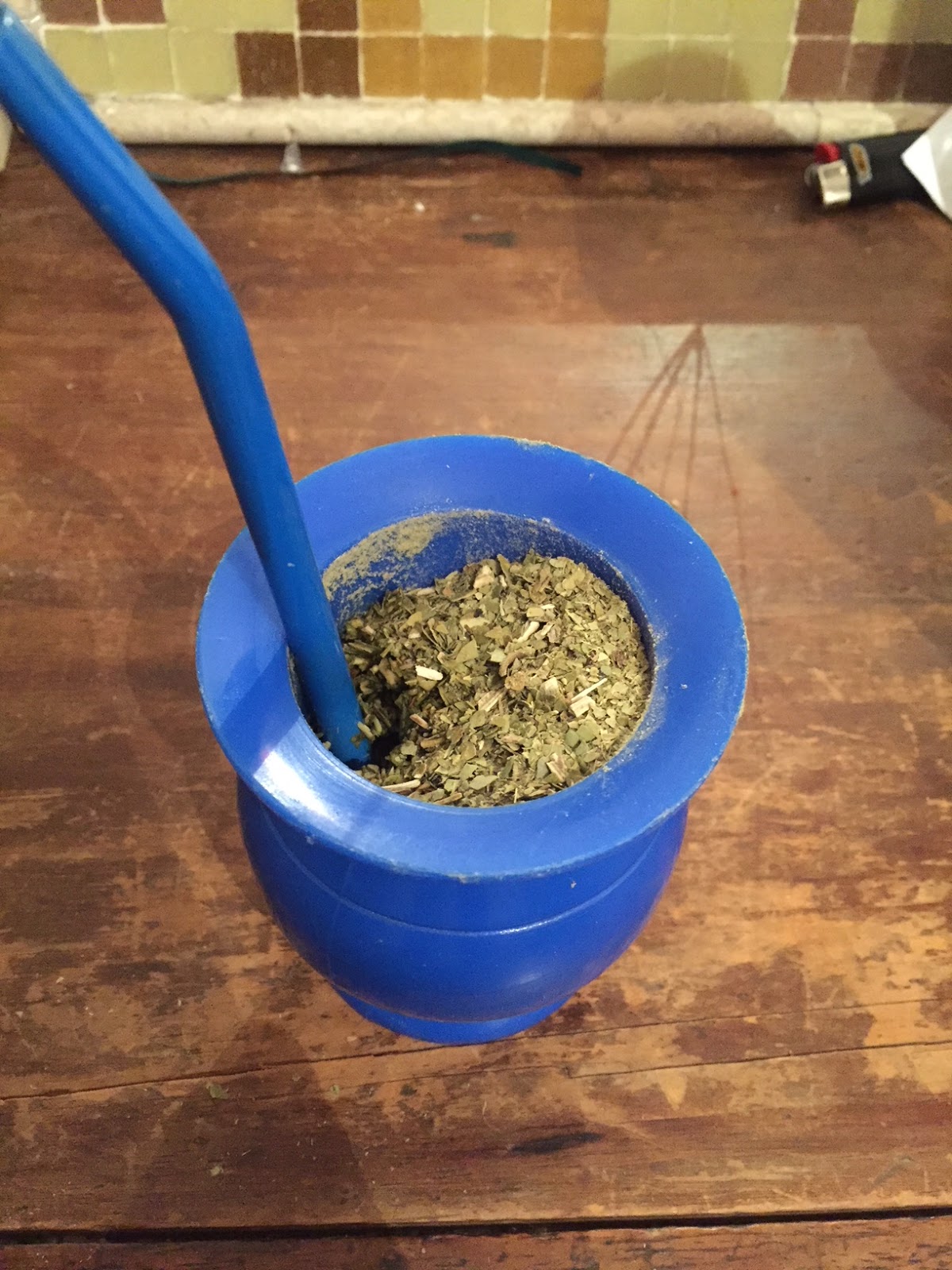
When I return to the US a plan of mine is to meet with many of you and share mate (or coffee, tea, tacos, ice cream - I am not picky). Mate, pronounced mah-tay, is one of the most popular drinks in Argentina, Uruguay, Paraguay, Southern Brazil and is consumed year round by people of all backgrounds. It is a drink similar to tea but made of the yerba plant which gives the drink it's bitter, herbal flavor; although other plants can be added to alter the taste. The drink is caffeinated with a different caffeine compound than coffee so the energy it gives is less of a powerful jolt and more of a long-lasting effect. I do not allow myself any mate after 8pm or I won't be able to sleep until after midnight!
The act of preparing and serving mate is considered by many an art instead of a task. Although there is yerba in teabags, called mate cocido, typical yerba is drank out of a gourd or glassware also called a mate. There are many different kinds and styles ranging from squash gourds, wood, glass, metal, ram horns, plastic and silicone. The yerba goes into the mate loose leaf and the straw filters the liquid.
Metal Bombillas (pronounced bom-bee-shas)
The bombilla, or straw, is made of metal and reusable. At the bottom there is a filter which separates the yerba from the drink. There are various styles and designs of bombillas depending on the size of the mate and the consistency of the yerba. For example, the silver bombilla in the photo above is larger in size and has bigger holes as it is made for less finely ground yerba and a larger vessel.
The first step in preparing mate is filling your mate about 3/4's full of yerba because the water will make it expand some. Mates are typically fairly small and the usually hold 4 or 5 big sips each serving.
You want to cover the top of the mate with your hand and turn it over, lightly shaking it. This is so the finer pieces and powder fall to your hand meaning that the bigger pieces are toward the bottom of the mate, preventing the bombilla from getting clogged.
The next step is to create a pocket for the bombilla. You want to use a little water, some prefer cold while others use hot, to slowly wet the edge of the yerba, making a nice little hole for your bombilla.
The matanero or matanera is the server of mate and is in charge of filling it for each person, passing it in rotation and adjusting the bombilla. They always have the first drink of mate to make sure that the temperature and bombilla placement is correct (and usually get yerba in their mouths).
As you can see, only the area around the bombilla has had water poured on it. That is because it is very important not to drown the yerba by pouring too much water or in too many different areas or else the flavor will be ruin. Furthermore, the water should never be boiling or it would ruin the taste (and burn your taste buds).
You can also add sugar which is especially popular teenagers who are just starting to drink mate. There are many different brands that offer bold, strong flavors as well as smoother, softer yerba. Also, there is flavored yerba like orange or grapefruit and yerba mixed with herbs such as chamomile or mint. Sometimes this is for specific aliments like nausea and sometimes just for taste,
Juan Pablo, Ivan, Leandro, Rodolfo, me and Carlos were all excited I wanted to serve mate after church
Mate is one of my favorite traditions here because it is an act of community and sharing. The mate is passed around the circle and all are invited to share regardless if you are close family or if you just met. It may seem unusual to people of the US who don't want to share straws with their friends much less strangers but here we trust that if someone is sick they will not participate. There is a strong cultural attitude of sharing here in almost everything food related - I have had children from disadvantaged backgrounds share their cookies and potato chips with me and everyone around them without any prompting.
Mate is sharing in more than a drink; it is sharing conversation and time together. It is drank when taking a break from work or sitting in a plaza with friends. I have engaged in lighthearted jokes and funny stories, serious debates on the state of the society; yet sharing in tranquil conversation with easy silences is the most typical way the time passes. In the beginning it was something strange and uncommon but now I have drank mate thousands of times and in a circle with hundreds of people (not all at the same time though).
Every Sunday after church service everyone is invited to share mate in the church office and we catch up on each others' lives. I drink it daily with my friends at my work and share it with my housemates in our patio or in the plaza. It has been part of so many moments this year; as I take the drink home with me, I will take the memories as well.
Every store sells lots of yerba but the aisle at Walmart is extra impressive
Nichole and Rosita drink mate tereréin the summer
First week in Buenos Aires, I drink mate in the winter
Michaela and Beatriz like mate
Kitty likes mate
Even Pope Francisco likes mate
Any questions or criticisms (looking at you Argentine friends) please leave a comment below!
Want to learn more about the YAGM program? Please check out the Young Adults Global Mission page on the ELCA website.
In the busy months before leaving for Argentina (which now feels incredibly far away) one of the many preparations and considerations for the year ahead were the clothes I was packing and if I wanted to alter my style. It was not that I planned to break out my thrift store rose corduroy bell-bottoms (although I am waiting for them to come back into fashion daily); instead I was contemplating getting a shorter, boyish haircut or a rainbow flag tattooed on the back of my neck. I was considering adopting a more masculine style and dress so people would not assume I am heterosexual and rightfully suspect that I am a lesbian.
LGBTQ Pride Flag under the Argentine Flag at the Facultad de Bellas Artes
I, Joy A. Reason, declare myself a lady-loving lesbian to all; even to those uncomfortable with it (and especially guys looking for a date). This is not the first time I make a public announcement of whom I am attracted to and it will not be the last. Strange that folks need to come out of the closet and make statements about their private lives if they are not straight. Then again, we live in a world where thousands of LGBTQ people live in danger of being themselves; that I can publicly be myself is truly a privilege.
I am assumed to like men due to my choices in makeup, high heels and a style typically considered girly which does not fit the lesbian stereotypes. People are defaulted to be straight in our heteronormative society, especially if they fit the traditional gender roles. Furthermore, as a member of a religious organization and a missionary with the Lutheran Church being gay may seem like a major contradiction and even incomprehensible.
As a whole the Evangelical Lutheran Church in America is an open and accepting body that welcomes people of many sexualities and identities, recognizes and performs marriages between same-sex couples and ordains pastors who identify as gay, queer, lesbian, bisexual and other non-heteronormative identifications. It is near impossible to reduce such complexities to simple statements but the idea is everyone is welcomed into the body of Christ as children of God. Official language and stances of the church regarding human sexuality was published in a set of ordinances passed in 2009. More information on this comprehensive statement can be found here ELCA Human Sexuality.
Very often people from all religious backgrounds are surprised of the progressive attitudes of the ELCA. However, this statement also gave individual congregations the freedom to be as conservative and traditional as they choose or feel they need to be. There is no consensus on concepts of human sexuality and morality in regards to the biblical scriptures and Christian tradition. The church calls for mutual respect and for guidance that seeks the good of all; this includes honoring the beliefs of people from the LGBTQ community as well as those who believe being gay is a choice and a sin.
As a teenager I struggled with understanding myself and my sexuality for a long time, especially in accepting that it was ok for me to be gay. I completely embraced dear friends identifying queer but I wasn’t sure if it was ‘right’ for me to be that way. While I firmly believed that God created all my beloved friends exactly how they were meant to be, I questioned if that applied to myself as well. It took years of questioning, trial-and-error, and a life-long crush on Luna Lovegood to come to terms that being queer is part of my identity: it is unchangeable and it is beautiful.
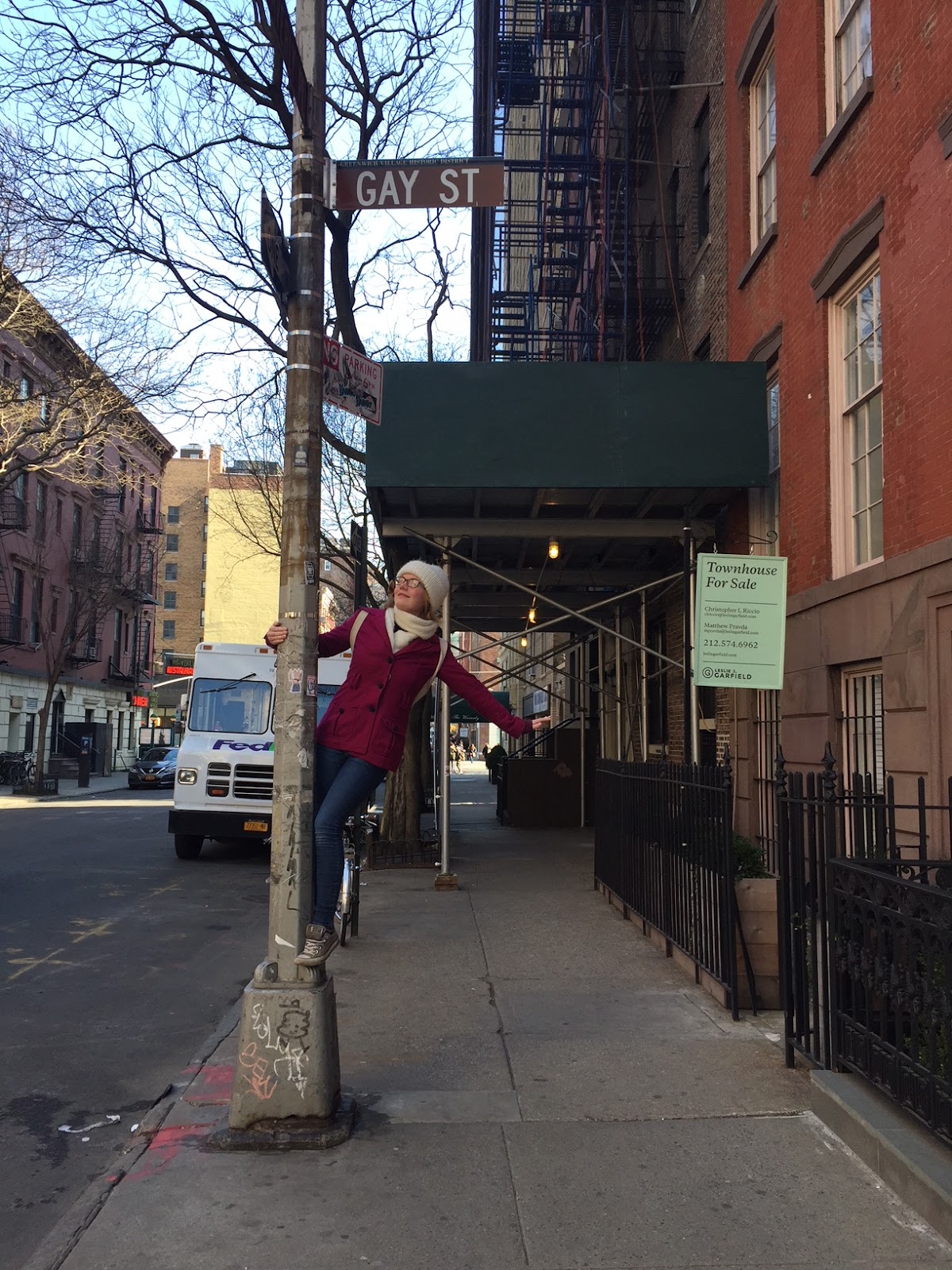
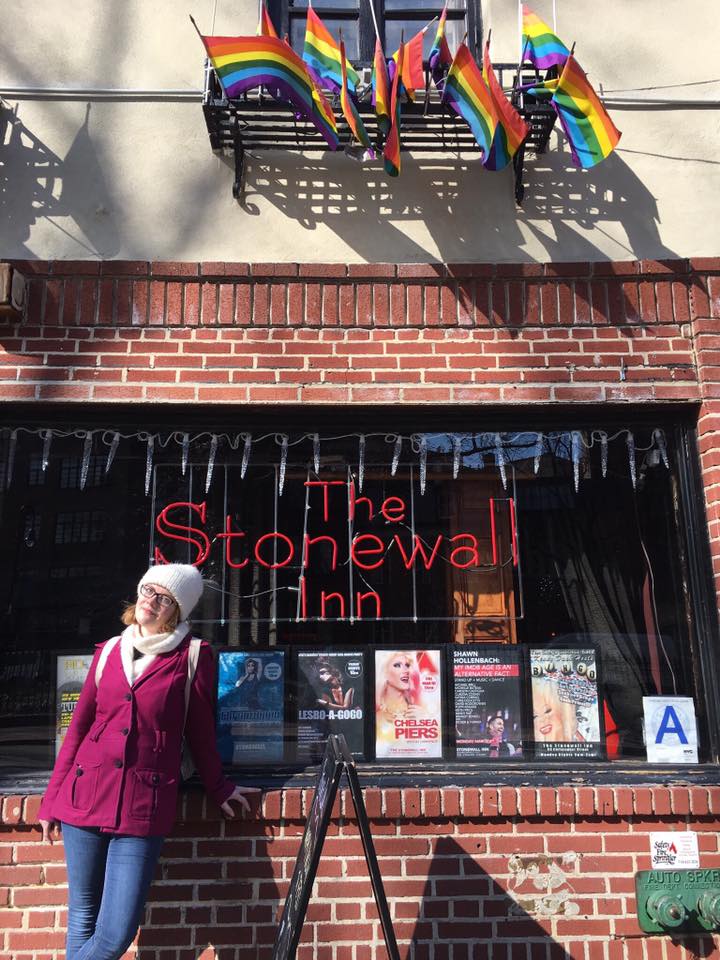
Embracing the gay in the West Village, New York City in March 2017
Author Nina LaCour says “People talk about coming out as though it’s this big one-time event. But really, most people have to come out over and over to basically every new person they meet” which was one of the truest statements I have ever read. I naively expected that after I posted about my sexuality on Facebook that no longer would I need to explain who I date or how I identify. But actually when you are constantly assumed to be something you are not than if you do not explain the truth it feels like you are hiding a part of yourself.
I wasn’t sure if I wanted to hide a part of myself away during this year of relationship forming and integrating into a community. After sending my application to the Global Mission office, I sent an email to the director of the YAGM program, Julie Rossate, sharing my thoughts.
I wrote “At first I thought I would prefer to stay quiet about my sexuality if I was offered participation in this program. I am a feminine woman who understands that different cultures have varying ideas of what is acceptable or allowed in society. I am confident that I can live in a society that believes being queer is immoral or wrong. Not that it would be easy to live like that but in reality it's another societal ill - along with racism, sexism, and classism - that is a part of this world. However, I realize I may be (grudgingly) accepting of homophobia in a large society, I can not say that about my community. I want to be a part of a community where I can be honest with myself and with who I am. I know that there are likely people in every community, including in my daily life in America, against LGBTQ rights and people and that is somehow tolerable. Many of these people need education or exposure to change their heart. However, I would not want to be placed in a community where everyone believes that it is a sin to be gay. I would want to be able to be open about my sexuality to at least a few of my brothers and sisters, to the people I share my daily life with.”
The Young Adult in Global Mission program has been refreshingly thoughtful and accommodating to LGBTQ folks. From a support group made of past YAGMs that met at different times during events to a session discussing discrimination and dangers LGBTQ people face in society during orientation. There are quite a few site placements and countries programs that are not favorable for those who identify as not hetrosexual yet every year the program is looking to expand to friendlier and safer sites. I have been extremely fortunate to have been able to be placed in Argentina and with the Lutheran church of the IELU which are open and accepting of the LGBTQ community.
As a person part of a marginalized community I am typically cautious of how I speak of my sexuality. A common question I am asked when people first meet me, besides what state I am from and if there is snow, is “tenes un novio?” which is if I have a boyfriend. When I first arrived and was unsure of the climate of the culture I would answer “no, no tengo una novia”; it was assumed that I misspoke as I changed the -o to an -a, not that I was saying that I did not have a girlfriend. Now, with more confianza in myself and the people around me, I actively explain that no, I am interested in women.
Depending where I am at I get a lot of different responses. The first person I told at my work at the community center was Auxi who teaches in homework help; she said "Que linda!" which is “how pretty!” or “how great!” and a phrase used quite often in Buenos Aires. Compartiendo Un Sueño is a organization centered on children and there I get the most questions about my life from kids and adult alike. They are all asked with innocent curiosity and a genuine interest in learning more. I truly love answering and entering dialogue with them because I know I can share my unique experience and some of my culture with them just as I learn so much from them daily. The most remarkable thing is that it is not a big deal at all; it is stranger that I can not roll my R’s than whom I date.
While I am always willing to engage in dialogue with people who only know of lesbians from television and stereotypes, it can be relieving to not be a spokesperson and just be myself. A significant moment this year was when talking to my housemates in casual conversation, I mentioned to them that I do not date men and my friend Pilar said in an offhand way (in English) "I know it". It was refreshing to not need to explain or go into detail but that this part of my identity is already common knowledge and accepted as a part of me.
During the month of January there was an accampartmento with the youth of the IELU in Greater Gran Buenos Aires. Pastor Ava, Pastor Daniela, myself and 7 teenagers slept in tents, had water balloons fights and made friendship bracelets during this fun week. Teenagers are remarkably similar across cultures like the boys scaring the girls and everyone wanting to explore the old creepy house on the property. Something I was not used to was that the teenagers planned their own devotions. The theme of the week was “Una Cultura de Paz” or a Culture of Peace and it was up to them to decide what that personally meant to them
The first day was centered on violence and they planned devotions and skits that explored this strong topic. The next day they planned a devotion on identity and being different in sexuality or gender. They discussed how it must be difficult to live within society and how people can be considered weird, immoral, sick and outsiders. Pastor Daniela lead them in thought provoking questions like how jokes may be very harmful or how people can use the Bible or Christianity to harm others rather than love others. I shared that I identify as a lesbian, some of the complexities of sexual orientation and appearance and of living as a Christian in a world where those identities do not seem to match. I was wonderfully embraced by all in the group, both in body and spirit.
Having positive and accepting experiences this year has been both healing and affirming. It is true that not all people of the IELU or all Argentines are so accepting but I have been blessed to inhabit a place where I can totally be myself. I felt no need to avoid the truth when talking to an elderly lady or awkwardly joke when asked about having a boyfriend. Every encounter I reveal this part of myself carries some sort of risk; a risk of criticism, of being labeled as unnatural or a sinner or moral corrupted. What is interesting is that I am more vulnerable in many ways in my life here yet more confident in revealing my sexuality.
It is not the fact that Argentina legalized same-sex marriage 5 years before the US did or that the IELU released a similar statement with stronger language just one year after the ELCA (IELU Mismo Sexo) that makes me feel more comfortable. It is that I have needed to trust others more in my daily life; from small things like asking strangers directions to the bus stop but also scary things like trusting others with the knowledge that I am different from them. Trusting that even if people do believe I am morally wrong in my lifestyle or mentally confused that I will be shown respect, acceptance and hopefully love.
Today I trust you all to do the same. I may have anxiety of getting bible verses thrown in my face or gossip being passed around. There is even the fact that some of you may want to disengage and no longer want to follow my journey. But my heart knows that I have so many walking alongside me no matter what my sexual identity is.
My supportive CUS friends Auxi, Caro, Lauty,Paula, Olga and Rami
Taken at the Bosque in La Plata. The horses were not tied up, just enjoying the day as well.
Some mushrooms I found in the forest. I did not eat them because mushrooms taste bad.
Tranquil beauty away from the city.
Hola everyone!
Hope you are enjoying the changing of seasons, whether it is fresh springtime with flower buds or the colorful trees of otoño as I see here in Argentina. This post is a little bit later than intended and not originally planned but I have had a busy few weeks. The universities began classes so my city has been extremely active with the dynamic student population. The plazas are again filled with young people sharing mate and music is heard from various apartments all the days late into the night. Also, there is the knowledge that I only have a few months left in my communities and with my friends so I try to be as active as possible and fully enjoy each day.
When I reflect on the limited time I have left in La Plata (only 11 more Fridays!!) I ask myself if I have done everything I wanted and if I have been the person I intended to be. Before I packed my suitcases for this year of service, I had numerous plans for self-improvement. While I had the wisdom to enter my new communities with few expectations of the places or the people, I had many personal goals I wanted to execute during this time abroad.
In some ways focusing on myself is vital to living healthy. The times I have not paid attention to my emotional health were times of frustration and saying things I regretted. When I did not focus on maintaining good physical health I found myself eating delicious alfajores for dinner - only these sweet cookies and nothing more. Finding a balance between time alone and time cultivating relationships has been essential in feeling supported and loved while recharging my own energy. It is important to be self aware in order to make positive decisions and habits in regards to all dimensions of health.
Furthermore, I do try to challenge myself in order to promote growth. This year has been significantly slower paced than past years which has given me a lot more unstructured time. I have learned to cook different recipes, rediscovered my love of reading and have made crafts such as a pillow out of jeans or candle holders out of tuna cans. I honestly see many ways I have grown from a mixture of nurturing and pushing myself.
I am proud of my accomplishments which ranges from making a tasty zucchini lasagna for a special summer evening to talking to vendors at the park. I am full of successful moments and experiences and enjoy reflecting on my triumphs.
Yet what about the failures and times of struggles? Those days when dark thoughts fill my mind and the major accomplishment is washing my face and getting dressed in anything but sweatpants. Instances when I get into a depressive mood, a negative funk, and I focus on all the things I need to work on like my need to be more prompt, more honest, more structured and overall a better and improved Joy.
The idealistically made plans of self-help often quickly transforms into a mindset that I can andI need do everything and anything alone. The reason why I feel bad about myself is due to my own mistakes and shortcomings so it is my responsibility to correct this in myself. I made my bed and now I have to lie in it.
Perhaps there is some truth in personal responsibility but I believe it is, at best, isolating and unnecessary. So often are we are own harshest critics; we hold the highest standards, punish ourselves harshly and speak to ourselves with cruel words. When thoughts of myself are at the center of my life I can be wrongfully proud during the good times and painfully ashamed in periods of struggle.
Overly focusing on myself not only distances me from the people around me but also from God.
I become closed from my friends and loved ones when I get stuck on myself. When we are ruminate on our flaws or act like we alone accomplished our victories, we are turn away from connection with people and with the Divine. How often does my desire for independence cause me to only see my own lonely steps and ignore others walking alongside me?
On Viernes Santo, Good Friday, I spent the evening at a nearby church; after the mass we went on a Camino de Cristo or a Christ Walk. While I did not know the Catholic prayers or understand all of the songs, I felt connected with this varied group who gathered to remember the path Jesus walked. I saw the yellow leaves fall with the wind under the streetlight and I thought of death. I could see the constellation of elCruz de Sur along with Orion in spaces of sky between the apartment buildings, reminding me where I stand on Earth. I stumbled in my platforms boots on the uneven sidewalk but two women steadied me, not allowing my to fall. I thought of community and togetherness and how Jesus came not for the Chosen People but for all. He came for all us broken people and we do not need to hide our imperfections and flaws even though we try to so desparately.
This post is a break within my series on poverty because for a moment I was so focused on my own short-comings and failing that I hesitated in speaking out against injustices within our world. I felt that it was hypocritical to use my words to criticize sinfulness when I myself constantly turn away from God.
Yet I read a powerful quote from the inspirational Reverend Dr. Martin Kuther King Jr the other day. "An individual has not started living until he can rise above the narrow confines of his individualistic concerns to broader concerns of all humanity".
We will never be able to become the improved, idealized people that we imagine and, like children, we will always be stubbornly trying to do things our own way. Time and time again do we have to realize that we are making ourselves the center of our lives and we will then need to turn around towards God and our loved ones.
Because if we stop focusing on our own solitary life than we can clear our eyes and see this beautiful world bursting with life. We can open our eyes to the suffering and pain but also to the hope, laughter and love that so vibrantly fills this world. We can open our hearts to those suffering and open our mouths against injustice.
Turn around with bright eyes away from yourself toward something more.
(Emotionally singing Bonnie Tyler can be the first step in turning around)
Maybe you are searching for the feminine in God like in Nuestra Señora de Guadalupe at Cathedral of La Plata
This is an age that places the highest value on certainty. We want our leaders bold and unfailing in their convictions and prefer politicians who are confident and refuse to be questioned. Technology and the internet has made the practice of fact-checking easier than ever (yet somehow presenting articles with conflicting information). People are criticized for questioning our social institutions because of our unwillingness to be uncertain or critical of such important parts of our communities. Even many of our institutions that acknowledge the supernatural and the sacred push the idea of an irrefutable certainty of beliefs.
As the week that Christians call Holy Week is upon us, I wanted to speak about the poor of spirit. My last two blogs in this series on poverty have focused on economic poverty, something near and dear to my heart. Yet I am also a deeply spiritual being that aches at the disconnection that exists between our religious communities and folks searching for food for the soul.
I believe there is a spark within, something I call a soul and that we are not just functioning nervous systems controlling our limbs and organs. We are not our thoughts or our memories or our bodies but something else. A heart, a soul, an essence that is created by someone or something Divine. This belief of a sacredness within would have existed without my religious background.
I have been beyond fortunate to have been raised in a religious community that fed me nourishing words of love, hope and acceptance. I believe that even if I was not brought up in a community of faith, I would have still searched for something to satisfy my spiritual needs. Being spiritual does not necessarily mean being religious. Religion, which has been a part of humankind for over 100,000 years, creates a unifying system that has three elements: the sacred, beliefs and practices and a moral community.
While I see many wonderful elements of faith communities such as the abundance of friendship, guidance, and comfort, I understand how many people have been deeply hurt by organized religion. Churches have been exclusive, judgmental, and self-righteous. The same people who are marginalized in society are often on the margins in our religious communities as well. I know many individuals who had toxic experiences with organized religion which have put them off religious communities in their adulthood.
However, the need to have absolutes is another factor that drives people away from religion. On one hand, religion gives explanation and a type of peace to the chaos that is our world. We live in a scary place full of heartbreak, injustices and extreme inequality; we crave something that makes sense of both the pain and the joy that we experience. However, we are also unwilling to not have all the answers.
Perhaps you have heard someone (other than Drake) say it was "God's Plan" in the face of a tragedy or that "everything happens for a reason". I see this need to justify terrible events as more for the person giving comfort than the person who is experiencing the devastation. When a religious person say these types of statements to a person experiencing great loss it creates the image that God is making you feel pain for a reason. This idea that God is inflicting this on you personally leads to the thought that you did something wrong or bad to have caused this event.
A better alternative is I don't know. I don't know why that drunk driver hit you car. I don't know the reason why you had a miscarriage. I don't know why your child has cancer or your father died when you were young or you are suffering with depression. Because tying to answer these questions is something we will never be able to do in this lifetime and using God's rightness as an excuse is wrong. God should not be seen as the Punisher but of never-ending compassion, love and grace.
Besides the certainty some try to promote during time of darkness, there is also the hesitance of questioning anything at all. When someone starts questioning if the bible is God's perfect word they may not share that with their Christian community and instead stop attending bible study. When someone is looking for the feminine in God and Christianity they may withdraw from the Church in search of satisfying their spiritual needs elsewhere. Someone who is doubting the existence of God may leave their circle of religious friends out of fear of being forced fed their explanations and beliefs.
In Jesus' famous Sermon on the Mount he says "Blessed are the poor in spirit, for theirs is the Kingdom of Heaven" in Matthew 5:3. This is a message for those questioning God. Jesus is saying it is fortunate to be uncertain in religious laws and promises because the alternative is being so sure in your convictions that you are closed off from others and from God.
The poor in spirit, the ones questioning faith are suffering as they challenge the world and what they determine to be the truth within themselves. Yet they are rich in their uncertainty; they do not settle for a religious teaching which does not ring true to their souls. They question religious institutions that speak words of exclusiveness, superiority and promote blindness to social issues.
For the readers who are strong in their convictions: please be patient and open to those uncertain in their beliefs. Perhaps you will be moved by their faith journey.
For the readers who are unsure what or if you believe in anything: listen and care for that voice within. Acknowledge that there are forces in life you do not understand. Do not be afraid to read, visit, and interact with other religions or spiritual practices. Understand that there are non-judgmental people willing and wanting to be a part of your exploration.
Muchas gracias for reading!! See you next with part four of my series on poverty!
Shame can make you feel alone - like waiting for the Line C in Buenos Aires early New Year's Day
The American Heritage Idioms dictionary defines 'crying shame' as an unfortunate situation. It is a term suggested to have come from the now obsolete to cry shame upon, meaning to express vigorous disapproval. These days we refer to both mild annoyances and tragic circumstances as 'a shame', sometimes add 'crying' for dramatic or humorous effect. 'It's a shame that I broke my watch' and 'it's a shame that the family died in the fire' are very similar except the seriousness of the situation.
Yet more and more I like the original expression - it truly gets the gravity and heaviness of what we call shame. Shame is the painful feeling or experience that makes us believe that we are flawed; that something we've experienced, done, or failed to do makes us unworthy of connection, love and belonging. Shame has been described more as an experience than a feeling - a flush of heat reddening your face, feeling sick to your stomach and mortifying embarrassment.
The research of BrenéBrown, esteemed social researcher and author, is the basis for much of my understanding of shame and how it is used in our society. Through years of research and interviews with people of all ages and backgrounds, one of the findings is that shame is a powerful isolating force that can only be healed through connection and empathy.
We all have felt shame throughout our lives and people feel shame for different reasons. For one person, something insensitive may be brushed off or met with embarrassment. For another, it can deeply wound.
One example is when discussing weight and diet. Let's say a coworker sees their colleague eating fast food a few times during the week and says something like "Wow, you are lucky your body can handle that. I would look like a cow in no time with that diet". Someone who has a positive view of their body may be able to just roll their eyes and let the insidious comment go. However, another might have struggled all their life with their weight and body image - they may remember the mean nicknames, diets their parents implemented, and the sense that they are ugly because they were/are overweight. This type of comment could be very harmful and shameful, leaving the person feeling raw and exposed.
People can feel shame about their bodies, professional life, romantic life, parenting, and more. Nobody wants to discuss the things they feel shame about because sharing vulnerabilities is risky. To open up about our deep hurts - how we feel like a failure and an outsider with something wrong with us- is completely terrifying.
Yet it is necessary. If we stay silent with our shame, our hurt grows. The only way to combat shame is emphatic connection - knowing that you are not alone.
Lástima
One night my friend Pilar and I was sitting on the terrace of our house, sharing a beer and discussing social problems in a mixture of English and Castellano. She said has lástima for the people who live in the streets and asked me the word in English. At the time, I did not know the translation but now I know that lástima means pity or shame.
Not only do I have pity for people suffering homelessness but I also feel immense personal shame when the topic arises.
(Actually, in my head and aloud, I often refer to them as 'homeless people' or 'the homeless'. The stress is on the word 'homeless' makes it seem more like an idea or problem than a group of people.)
I am ashamed when I cross the street to avoid being close to a person who appears homeless. I feel shame when I give women or children money but not to men, as if they are less deserving. There is shame when a homeless man says something to me and I ignore him. Sometimes I catch myself staring at whatever shelter or meager materials a person possesses in curiosity; then the feeling mortified if I catch their eye. During interactions, I become uncomfortable and can ignore someone asking me for money - looking right past them as if they are not flesh, blood and spirit like me.
I feel shame in my interactions but also that they live an unimaginably horrible life and I do not.
Much of this part of my shame is guilt. Shame is a focus on self while guilt is a focus on behavior. Shame is "I am bad" while guilt is "I did something bad". I have guilt that I did/do not help more to lift people out of homelessness. Guilt that I am outspoken, yet my actions do not match up to my statements as I would like. But there is also a sense of shame that I have good things and I am not worthy.
In order for humans to deal with such unpleasantness we blame, rationalize and create distance between us and them.
Using blame, I tell myself that they probably make a hundred dollars a day panhandling - ignoring their dirty clothes and sickly faces. I shouldn't give them anything; they will spend the money on drugs or booze anyways. I worked earned my money; the reason they're homeless is because they didn't work hard enough or save their money. This narrative we tell ourselves gives relief to our bad feelings and a logical excuse to not help people in the streets.
We also take great pride in our community's outreach even if we do not know much about the organization. We give ourselves a pat on the back for all the work our centers do even if we have never seen or know the services and functions.
We carry an image the promotes the idea that homeless people are dangerous or criminals. An poorly dressed, unstable man who mumbles to himself is a classic stereotype of a person who lives in the streets. There is some validity in that image as many people who are homeless also suffer from mental health problems and poverty is a factor in crime. However, this stereotype can be used to exclude, judge, or harm someone unfairly.
Furthermore, a homeless person can be the decently dressed kids on the bus or the woman selling soap in front of the cathedral. People experiencing homelessness can be sleeping in their cars, living out of motel rooms, or couch surfing. They also can be actively attending school, college or a job. When you close the distance and realize that people suffering homelessness are a lot like you, it can make you fearful, anxious but also more likely to see the people for who they are instead of their living conditions.
Shame makes me want to turn away from homelessness because of the overwhelming complexities it makes me feel. Only through admitting these feelings to others can we discuss the shame regarding homelessness. Once we see that we are turned in on ourselves, we can begin learning, listening and reaching out to truly connect and help others.
Owning Shame
While we are ashamed of ourselves in certain social situations, we also have the experience of being shamed from others. This is when someone actively makes you feel wrong or flawed which disconnects you from the others who are 'normal'. It can be with direct statements or jokes or can be through subtle messages. People with the best intentions can make someone feel ashamed or it can be someone hurting and looking to hurt others. It can be two guys making fun of a third when he shared that Where the Red Ferns Grows made him cry as a kid or a group of women for chastising a new mother for choosing to go back to work after childbirth.
Our society - through advertising, media and stereotypes - also feeds of countless messages that we are not enough.
A person who grows up in a disadvantaged neighborhood can feel ashamed of their circumstances from a young age. Even if their peers are from the same area, there is still the certainty that being poor is bad which means you are bad. Some of the damaging messages from the world are that your parents are lazy, being poor means you are dirty or stupid and that you can be only happy with a nice house and expensive things.
It is the painful truth that having insufficient income for living comfortably results in a less healthy life with less opportunities. Also, in areas of low income and poverty there are other toxic issues such as high unemployment, poorly funded public schools, lack of accessibility to healthcare and high crime rates.
However, instead accepting the shame put upon them, I see people proudly claiming their culture. They have a different identity from people of other neighborhoods and social classes but they share the culture of the neighborhood. Many poor people take the negative opinions and criticisms, remove or embrace the stigmas, and proudly represent their culture and experiences.
In the United States, I see a culture that emerged from the inner city or the 'hood'. From the inner city, which are communities predominantly POCs, the first jazz, rap, break-dancing and hip-hop emerged. Fashion, hair styles, slang, and other elements of culture that were once localized in a marginalized neighborhood moves to mainstream culture as the edgy, cool new thing (and often omitting where or whom these elements of culture came from). A lifestyle that celebrities imitate and the businesses of fashion and music capitalizes on it.
In Argentina there is also both shaming and celebrating the culture of the rough, poverty stricken neighborhoods called the villas (pronounced VEE-shas). Villas are dangerous, extremely poor areas that lack proper housing and sometimes basic services such as trash removal, ambulances, and police. The people from the villas face discrimination, hardships and severe lack of opportunities. Yet, parts of their culture such as the music of Cumbia Villera or the rap artist Duki are now mainstream and appreciated by many. Someone from the villas may feel ashamed of his home or education but he feels proud of his style and music. It certainly does not solve or address the bigger issues of poverty but maybe with possessing a strength in himself, the man from the villas can find the strength to take on the larger issues in the world.
For shame to thrive it needs 3 things: secrecy, silence, and judgement. Maybe the reason I am so ashamed to discuss how I feel about people suffering homelessness is because it's something not polite or proper to talk about. We can talk about homelessness in abstract terms but we are never encouraged to befriend these people on the margins.
Perhaps people from disadvantaged neighborhoods have figured out that speaking up is what kills shame. That sharing our wounds and sorrows with others builds strength, forms communities and creates a unifying force that drives actual social change.
There are countless things to cry shame upon in this lifetime. Will you keep your pain inside and isolate yourself? Or cry upon the shoulder of another and God to grow through you weakness?
Please watch BrenéBrown's TEDtalk full of humor, heart and more of what I touched on.
Thank you for walking with me today. Feel free to share your thoughts, stories, disagreements or questions below, on Facebook or through my email. See you all next week!
Don't judge a man until you've walked two moons in his moccasins (in this case, second-hand sandals)
Months ago, in the middle of August, I began the first week of my program in Chicago. I remember the week of orientation was full of extreme emotions; the yearning to make a good impression, both grief and hope as we discussed global problems and solutions, and the ever shifting tide between excitement and anxiety. As I met 100+ young people from all over the country, both alumni who completed their year of service and newbies just beginning, I was eager to connect.
Yet, there was something that made connecting difficult. It wasn't my occasional off-key singing or not knowing any song lyrics or that I sometimes chew with my mouth open (gross, I know). Instead, this is something deeper that became part of my identity in childhood.
It is identifying as poor, as a member of the lower class.
I have little shame in the financial circumstances of my childhood, although my parents might. I was never hungry; food stamps and free lunches at school gave me additional food security. My parents always paid the electric, heat and even the cable bill on time. I had state provided healthcare and my parents somehow had the money to pay for orthodontics. We even had time and money to travel which is truly a great privilege.
However, from an early age, there were times I felt abnormal based on my circumstances. During back-to-school shopping I was allowed to buy 3 new outfits so I wore the same clothes often. There was the need to make my ripped jeans 'cool' instead of just old and ratty and that year when we all shared the Christmas present of new furniture.
None of these things are meant to invoke sympathy and in countless ways I had an amazing childhood full of love, support and, yes, adequate material possessions and security. Nevertheless, I have had some painful experiences that others my age may not be able to relate to, especially young adults from different financial backgrounds.
Today, I am a college graduate, have a closet full of clothes and traveled to Europe; all characteristics more common to the middle or upper class than working class. Yet, in many ways, I still feel like that girl labeled as 'poor'. They call economic class socioeconomic status because class is not solely based on income but on the social circles and culture a person relates to. After graduating college, I earned enough money to be more financially comfortable than my childhood; yet I still carry the habits and attitudes from my poor background. I love shopping at thrift stores, taking pride in finding name brand clothes for less and spending my money wisely. I know that the unexpected happens so I made sure to have decent amount in savings and good credit score by my early 20s.
Unfortunately, it is just not good habits that I carry with me. There is also a jealousy at others' unearned advantages and an anger at their blindness (ignoring the log in my own eye of my unearned advantages and blindness). In my teenage years, as I learned more of the injustices in society and the policies that keep the poor disadvantaged, my emotions oscillated between heartbreak and rage. I felt strong emotions at the inequality of our broken world and often released this energy towards unsuspecting people of the middle and upper class. At that time, I would rant when anyone complained about emptying the dishwasher because that had water, and dishes and a dishwasher! Probably a matching set of dishes from Ikea! So much more than so many!
Since then, I have pretty much come to terms with the ugliness inside myself that unfairly classifies people due to social class. I see the world in more shades of gray than in black and white and I know it is unfair to stereotype someone and blame them for societal ills.
Still, subconsciously, I have feelings of being unable relate to people who are of a different economic class. It seems that Young Adults in Global Mission has a uniform of expensive sandals, iPhone 7s and a private education that I did not know about and can only partially relate to.
It sounds materialistic and image conscious yet objects are the easy things to compare. It is harder to admit that when I hear of my friend with a near perfect smile lamenting over a future with braces, I shamefully think of my mother's rotting teeth and her need for serious dental work. Or when my friends share stories of their rough days in college, I think of the semester I worked 40+ hours during the weekends and failed half my classes.
By many standards of American society, I have the security, finances, education, and access to healthcare that sets me above the poverty class. Living my life here, I have an even greater privilege of wealth, security and personal freedom. It seems like a contradiction that I both have tremendous amount of privilege and identify with the lower class, yet it is the truth. Internalizing the message that I am part of the working class and it developing in my identity is just one of the many complexities surrounding poverty.
I had a brand new Barbie bike WITH tassels for my 5th birthday!! Such privilege!
Currently, Christians are in the season of Lent, or Cuaresma in Spanish. It is a time of year is for acknowledging the sinfulness and brokenness of both ourselves and of our society. The focus is on repentance - a turning away from wickedness - and how a relationship with Jesus the Christ is necessary leave our old selves behind.
This Lent, I want to take you on a journey with one of the greatest societal sins: poverty. The next four weeks I will be sharing the poverty here I see in Argentina, the complexity of our attitudes toward the poor and the role of social institutions such as churches.
Undoubtedly, people from the United States are very generous in helping the poor. I am impressed with the speed and effort many undertake to donate food, water, and money to areas affected by hurricanes, tornadoes and other natural disasters. Numerous people regularly give their time and energy to helping the needy. On the other hand, Americans also have many arguments as to why they should not help the poor. People do not support policies that raise people out of poverty and demonize the lowest in society, blaming poverty on moral degradation of the individuals.
I want to take a walk down this painful, broken path. Where complexities and false information thrive; where people are put against each other in the evilness of Right vs Left and the promise that political parties or religious institutions offer the absolute solutions. I want to talk about poverty and morality in an open, honest space where right vs wrong is more important.
Feeling uncomfortable? Ashamed? That's natural! Please read next week's blog about why it is so hard to talk about poverty.
As always, thank you for reading and for your willingness to stretch your mind.
Please feel free to email me or comment (I will know how to respond this time haha) if you want to chat more. See you all next week!
Micheala, Nichole and I freezing in the glacier lake of Nahual Huapi in Bariloche
While many of you are waiting for warmer days or waiting to see if Punxsutawney Phil's February prediction came true (an American tradition that I can't even explain in English), the summer sun has been shining down on me in the Southern Hemisphere. Myself, along with the other young adult volunteers across the globe, are issued around a month of vacation time during our year in service. Much of my January and February has been spent visiting my friends throughout the very different landscapes of Argentina.
One of the countless blessings I have received this year is Argentina's laid-back, tranquil culture; especially evident in the high value placed in vacaciones. It seems that the whole country is on vacation; even people who do not have much try to visit their family or go to the beach for the weekend. Many small businesses such as produce shops or bakeries close for a few weeks while the owners go on vacation. The summer season seems to be for sharing time with family, relaxing and trying to stay cool.
During our time off we are told to live within our adequate but humble stipends and be mindful of our host communities. Within this vacation time we are permitted to have our families and friends visit and during our program orientation we had thoughtful conversations about the implications extensive or lavish vacations can create.
Receiving visitors can be very complicated for volunteers. Besides planning logistics it can be difficult to share your new community with your visitors and for two groups of different cultures and languages to understand each other. While our guests are tourists who are wanting to explore and see all that there is to offer, we are residents who try our best to fit into our communities. There have been parents who visited in the past that stayed at pricey hotels and took the family to exotic, expensive places. I am sure that their top priority was to visit with their son or daughter but they may have their own idea of vacation; one that involves eating the finest cuts of Argentina's famous steaks, seeing the best tango dancers and staying in charming, upscale neighborhoods of Buenos Aires. In short, vacations that involve lots of money.
When I first heard of inappropriate vacations volunteers took in the past, it was easy for me to shake my head in a mixture of distaste, jealousy, and amusement. I knew that my parents could never afford to stay at a fancy hotel anywhere in South America - they would not even be able to afford a single flight. As I sat in my stylish yet second-hand clothes, I felt pride wash over me and an assurance that I would never be like those volunteers.
Pride and Joy sound like a great combination but I was thankfully knocked off from my polished pedestal. The universe was quick to remind me of the sheer amount of social and economic privilege I do have; both in my life in the United States and as an American in Argentina. My life is overflowing with unearned good fortune - I see former classmates and other young adults who would thrive in the type of program yet are unable to apply. So many hard working individuals who do not have the financial security or social support network to live in another country for a year.
Within my life here, my privilege is more apparent. My iPhone 6 cased in an expensive Otterbox stands our sharply against the iPhone4s; as do my numerous outfits compared to my friends who own only a few. Advantages I take for granted - like a straight smile by years of braces or the knowledge of riding a bike - remind me not all have had those blessings in childhood.
As vacation season comes to an end, my Argentine friends are interested in hearing of my vacation time since they have not had the opportunities to visit such famous sites. In less than 6 months of living here, I have traveled more than many people who have lived here their entire lives. I did not work hard or do anything to deserve this travel; I have just been blessed to have the freedom, money and invitation to visit the homes of many within this beautiful and diverse country.
Yet when I share the stories of my travels, it is not the actual places I speak about the most but the people who enriched the spaces. My memory of hiking up Cerro Cementerio is full of laughter, sweat and jokes as my country mates and I trekked the steep path (with accompanying music of Baird on mandolin). Seeing the Seven Lakes around Bariloche was breathtaking but it is getting sand in our pasta salad and our Seven Selfies that really made the excursion. The national park of Iguazu was stunning yet it was Beatriz's friend Rosita that made us all feel light-hearted and cared for. The lights of Paraguay across the river from Posadas was memorable but it was the song every Guenes sang along to the on the radio that was truly unforgettable.
I have a tremendous amount of privilege to have been able to have traveled so much in life. I pray that I tell of my travels with humbleness, openness and honesty. I hope that when I share the stories of my vacations, the people that touched my heart take center stage. Seeing God's work across the rolling green plains, sapphire lakes and picturesque mountains were honestly some of the most awe-inspiring, gorgeous sights of my life. Yet getting to know God's creation of beautiful people and personalities is a stronger blessing to me.
Rosita, Beatriz, Nichole and I at Las Tres Fronteras in Puerto Iguazu
In Beatriz's cabin after cooking something delicious (or at least edible)
Dinner at a fancy restaurant with the wonderful Guenes' in Posadas <3
Nico actually smiled in this picture of us! At the Jesuit Ruins of San Ignacio in Misiones
Looking cute in Bariloche
How we typically looked in Bariloche
Bible studying, music playing and enjoying each other's company during our second retreat
Big, genuine smiles after our hike on Mt. Llao llao (with 'our' seguros!)
Friends made on our 22-hour bus ride from Bariloche to Buenos Aires
Milk Jam looking fly in La Plata when they came to visit me <3